



A BCAA drink covers three amino acids and skips the other six. An essential-amino product can support synthesis and does nothing about breakdown. HMB is usually sold alone. An intra-workout adds electrolytes and stops there. Creatine, which now sits at the top of fitness search alongside recovery, handles the energy system and leaves the rest of the session untouched.
That gap matters more in 2026 than it did five years ago. The athletes filling HYROX heats, CrossFit classes, and concurrent strength-plus-conditioning blocks are not short on effort. They are short on a formula that can support muscle building and limit muscle loss in the same session. Feeling less sore the next day is not the same thing as coming back stronger. Strength-5 was built for that distinction.
The incomplete stack
Look at a typical “strength” tub, and the label usually checks one box. Branched-chain amino acids. Or a partial amino blend. Or a recovery powder built around glutamine. Rarely all of it, and almost never the peptide that has actual recovery data behind it.
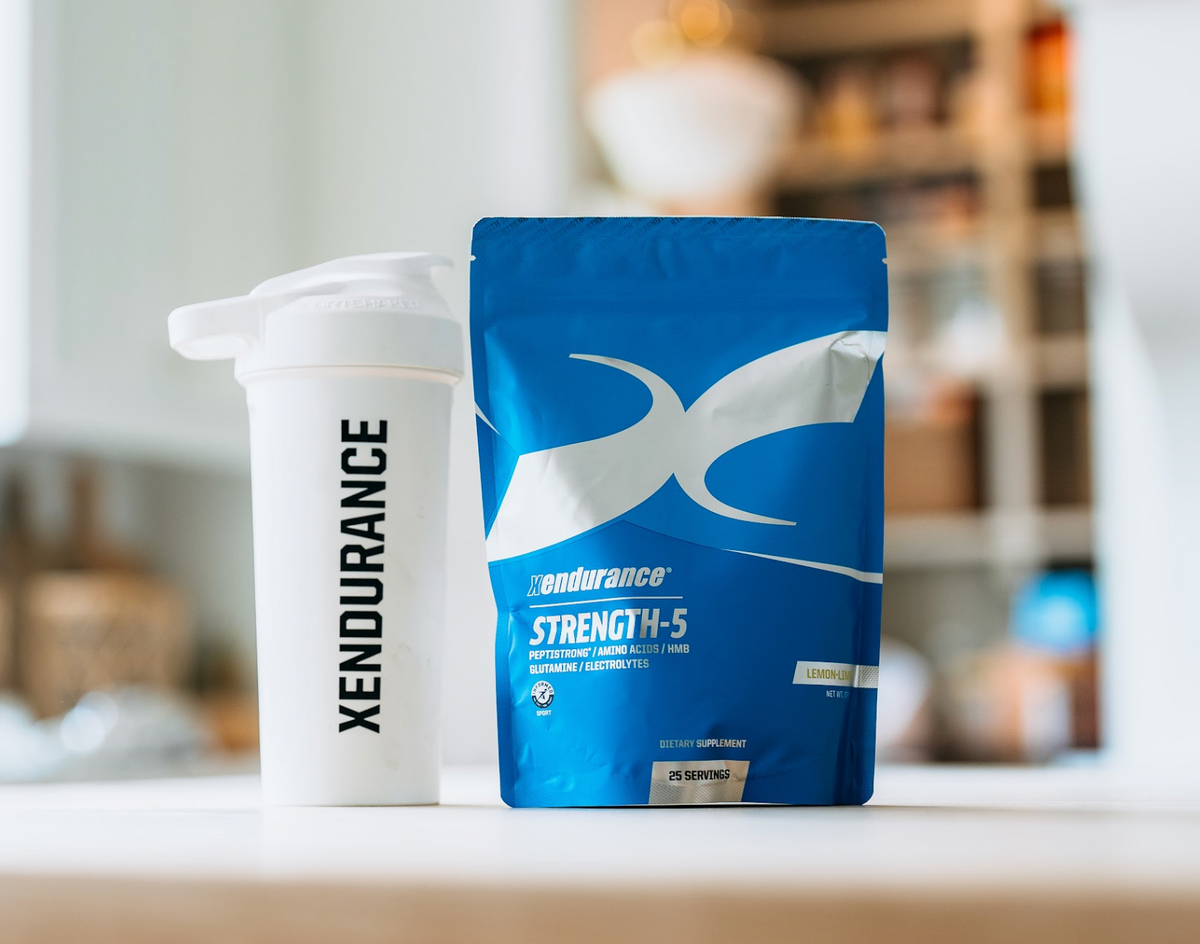
Strength-5 is the five-part stack most people assemble across three products:
- PeptiStrong, a fava-bean peptide network identified with machine-learning screening and studied in human trials
- A full essential-amino blend, about 5,400 mg, including the branched-chain amino acids leucine, isoleucine, and valine
- 1,000 mg of HMB (beta-hydroxy beta-methylbutyrate)
- 3,000 mg of L-glutamine
- Electrolytes, so the scoop can be sipped through the workout rather than chugged afterward
It is Informed Sport certified. The suggested use is one scoop in 8 to 16 ounces of water, sipped through the session, or mixed with another Xendurance powder. Lemon-lime. That delivery matters. Hybrid sessions do not wait for a post-workout shake.
What the peptide studies actually show
The ingredient that separates this formula from a standard amino intra is PeptiStrong, a Vicia faba hydrolysate from Nuritas. The consumer shorthand is “AI-powered peptide.” The more useful description is narrower: specific peptide sequences were screened from fava bean protein for muscle-signaling activity, then tested in humans.
The recovery trial that anchors the 30-to-45 conversation is Kerr and colleagues, published in Nutrients in 2023. Thirty healthy men, ages 30 to 45, took 2.4 grams a day of the hydrolysate or a placebo for 17 days. On day 14, delayed-onset muscle soreness was induced with resistance exercise. Strength recovery and fatigue were measured at 48 and 72 hours.
Over the 72-hour window, the peptide group recovered strength better than placebo (p = 0.027), showed less muscle fatigue (p = 0.041), and had lower plasma myostatin (p = 0.006), a protein that restrains muscle growth. Placebo lost strength at 48 hours and had not returned to baseline at 72 hours. The peptide group held strength and was above baseline at 72 hours. Reporting on that trial translates the strength-recovery difference into a 144 percent higher recovery rate versus placebo, with about a 54 percent advantage in isokinetic leg-extension performance over the same 72 hours and about a 47 percent reduction in muscular fatigue. Myostatin release was reported down 56 percent.
Those figures are peptide-study results in a specific protocol, not a promise that every Strength-5 user will post a 144 percent power jump. They are still the right numbers for this market. The largest recovery signal was in men 30 to 45, the same bracket now crowding hybrid races and functional gyms, and the one still being sold stimulant pre-workouts designed for someone else.
A second human trial, run at Maastricht University and published in The Journal of Nutrition, put the peptide network against milk protein in 30 young men during a week of single-leg immobilization and two weeks of remobilization. Muscle size and strength losses did not differ. Muscle protein synthesis during the remobilization phase did: the peptide produced higher synthesis rates than milk protein. Preclinical work on the same ingredient (Cal et al., Nutrients, 2020) found increased protein-synthesis signaling, lower atrophy-gene expression, and less muscle loss in a disuse model. A later resistance-training trial (Mohan et al., BMJ Nutrition, Prevention & Health, 2025) reported greater leg strength and muscular endurance versus placebo across 56 days of training.
Read together, the pattern is consistent. The peptide is not a replacement for dietary protein. It is a signaling ingredient with human data on strength recovery, fatigue, and synthesis during the period when muscle is trying to rebuild.
The other four jobs
Essential amino acids are the substrate. Muscle protein synthesis needs all nine, not three. Leucine is the trigger; the other essentials are the material. A 5,400 mg blend that includes the branched-chain amino acids is a session dose, not a dusting. BCAA-only formulas became popular because they are cheap and they mix. They are also incomplete. If the goal is a training drink that can actually support synthesis, the missing six are not optional.
HMB is the “protect” side of the formula. It is a leucine metabolite with a long research record for reducing muscle protein breakdown, particularly when training load, calorie deficit, or age is pushing the body toward loss. Classic trials often use about 3 grams a day. Strength-5 supplies 1,000 mg in the scoop, a practical intra-workout dose beside the amino blend rather than a claim that one serving replaces the full clinical HMB protocol. Stacked with the peptide and the essential amino acids, it is the piece most “strength aminos” leave out.
L-glutamine at 3,000 mg covers a different stress. Intense work draws down glutamine, which shows up in recovery, gut barrier function, and immune demand during heavy blocks. Three grams is a real supplemental serving, not a label sprinkle. Hybrid athletes who train twice a day notice this ingredient less as a pump and more as the ability to show up for the second session.
Electrolytes close the loop. Sodium, potassium, and magnesium support fluid balance and muscle function while the other four ingredients are being sipped. A powder you can drink through a lifting session, a metcon, or hill sprints is more useful than a capsule you remember afterward.
How it fits the way people train now
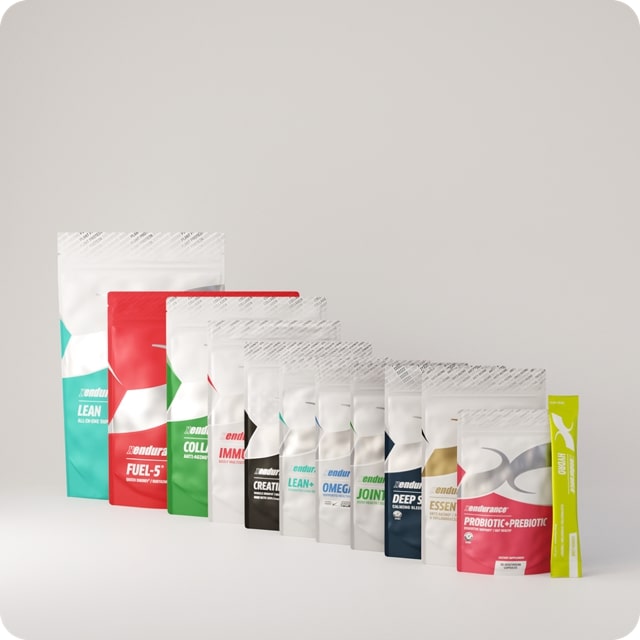
Creatine does not need to be displaced. It remains the best-supported strength supplement most athletes should already be taking. Strength-5 sits next to it: creatine for the phosphocreatine system, this scoop for synthesis, breakdown, and in-session aminos. That is also how the xendurance Strong Pack is built, with protein, Creapure creatine, and Strength-5 as three different jobs.
Use it where the session is mixed. Sip it through a lift before a conditioning piece. Sip it on a HYROX simulation day, when wall balls and sled work land on the same legs that were under a bar yesterday. Sip it on a hill-sprint day if the limiting factor is holding power late, not just replacing fluid. One scoop, through the work, is the protocol the formula was written for.
The 30-to-45 athlete is the sharpest fit. That group has the peptide recovery data, the training age, and the weekly volume that makes “build and protect” more than a slogan. Tested athletes have a second reason: Informed Sport certification is a filter, not a badge.
What athletes are saying
On the Strength-5 page, two-time CrossFit Games champion Justin Medeiros is quoted directly: “I sip on this during every training session now.” Jacob Heppner, on the same page: “Great taste, love it during my lifts.” Bailey Cook points to the practical reason most hybrid athletes add it: “Really feel it in my recovery and very important to me to get extra amino acids in my diet.”
Customer notes on the product page land in the same place. Tom Beck wrote that within three weeks of using it he had personal records in the split jerk and the strict press. Jan F. drinks it during workouts and hill sprints, and again after runs, and reports easier hydration during the session and noticeably better recovery after.
These are use reports, not clinical outcomes. They match the design: in the session, then again when the next day has to be trainable.
The case for switching
If the current strength drink is a BCAA, it is missing most of the essential amino acids, the peptide, HMB, and a real glutamine dose. If it is an EAA, it is still missing the protective side and the recovery data. If it is a post-workout protein shake, keep the shake. Protein is still the meal. Strength-5 is the scoop that covers the hour the shake does not.
The attention in fitness right now is on recovery that restores performance, not recovery that only dulls soreness. The peptide trial in men 30 to 45 is one of the few ingredient studies that measured the thing athletes actually lose after a hard day: strength at 48 and 72 hours. Strength-5 puts that ingredient in the same serving as a full essential-amino blend, 1,000 mg of HMB, 3,000 mg of glutamine, and electrolytes, and asks you to drink it while the work is happening.
That is the argument. Not more ingredients for their own sake. The jobs hybrid training creates, covered in one scoop.


コメントを書く
このサイトはhCaptchaによって保護されており、hCaptchaプライバシーポリシーおよび利用規約が適用されます。