




Hard sessions beat up more than muscle. Tendons, ligaments, cartilage, and the rest of the connective-tissue network take repeated load from long runs, HYROX stations, heavy squats, hill repeats, and hours on the bike. That is why collagen shows up in so many endurance and hybrid athlete stacks—and why the most common question is no longer “does collagen matter?” but when to take it.
Do you only scoop it after a brutal long run? Or is it more like a daily habit, closer to how you treat electrolytes, sleep, or total protein?
Short answer from the research we can cite: joint-focused benefits show up with consistent daily use over weeks to months, not from occasional post-session “rescue” scoops. Session timing can still matter if your goal is boosting collagen-synthesis markers around loading—but that is an add-on to daily use, not a substitute for it.
What the research actually supports
A 2021 systematic review of randomized trials on collagen peptides (or related collagen/gelatin forms) plus exercise found the clearest benefits in joint functionality and reduced joint pain, with some signals for body composition, soreness, and collagen synthesis depending on study design. Fifteen trials made the cut. Twelve of them involved recreational athletes. The review’s practical conclusion is straightforward: collagen is most useful for joint comfort and function when it is taken regularly alongside training, not as a one-off recovery product.
Key practical takeaways from that review:
- Daily doses in the trials commonly ranged from about 5–15 g/day (some studies used higher amounts).
- Joint-pain and function benefits tended to appear with weeks to months of use—not overnight.
- 15 g/day was associated with elevated collagen-synthesis markers in cited work.
- Collagen was not a match for higher-quality proteins (like whey) when the outcome was muscle protein synthesis.
In other words: collagen is better framed as connective-tissue support than as a muscle-building protein replacement. That distinction matters for endurance athletes who already juggle carbs, complete proteins, and a long calendar of sessions. You do not need collagen to replace your post-run whey or mixed-meal protein. You may want it for the tissues that take pounding every time you change direction, absorb landing force, or hold posture on a long ride.
The same review’s “practical implications” section is even more specific: 5–15 g/day of collagen peptides, taken for more than about three months, and preferably about an hour before exercise when the goal is synthesis, is the pattern linked to reduced functional joint pain and improved recovery markers. That is a protocol, not a panic scoop.
Why “only after hard days” usually under-doses the goal
If the goal is activity-related joint comfort, the athlete trials that moved the needle used scheduled daily intake, not sporadic post-race use.
One of the clearest athlete-specific examples is Clark et al. (2008). Varsity and club-sport athletes with activity-related joint pain took 10 g/day of collagen hydrolysate for 24 weeks in a randomized, placebo-controlled trial. Across several pain and mobility measures—including walking, standing, lifting, carrying objects, and changing direction—the collagen group improved more than placebo. Physician-rated pain at rest also favored collagen. That design matters. A 24-week daily protocol is the opposite of “I’ll take it if my knees complain after Sunday’s long run.”
The systematic review’s summary points in the same direction: roughly 5–15 g/day for more than about three months, with better compliance over that span, is the pattern linked to joint-pain and function outcomes. Later work in young, physically active adults with exercise-related knee pain has also found reductions in activity-related pain after 12 weeks of daily bioactive collagen peptides. The common thread is not timing around a single workout. It is enough collagen, often enough, for long enough that connective tissue has a chance to respond.
There is a biological reason the “hard-day-only” approach is a weak match for that evidence. Connective tissue remodels slowly. Collagen turnover in tendon and ligament is measured in weeks and months, not hours. Mechanical loading is the stimulus; amino acids (especially glycine, proline, and hydroxyproline) and vitamin C are raw materials and cofactors. If you only provide those building blocks after the worst sessions, you miss the rest of the remodeling week—easy runs, strength work, and rest days when repair is still happening.
Using collagen only after hard sessions also tends to produce a lower weekly dose than the trials used. Ten grams after two hard days is 20 g for the week. The Clark protocol was 70 g across the same seven days. The synthesis work that used 15 g was looking at that dose in proximity to loading, not as a rare treat.
When pre-session timing does make sense
Daily use answers the joint-support question. Timing answers a different one: how do I pair collagen with mechanical loading?
The 2021 review summarizes work, including Shaw et al. (2017), in which about 15 g of vitamin C–enriched gelatin taken roughly 60 minutes before intermittent exercise raised circulating collagen amino acids and collagen-synthesis markers more than a lower dose or placebo. Amino acids from the supplement peaked around one hour.
Engineered ligaments exposed to that enriched serum laid down more collagen and showed better mechanics. Subjects who took 15 g an hour before jumping work roughly doubled a blood marker of type I collagen synthesis (PINP) compared with placebo. Five grams was not as effective.
That is a useful, limited finding. It does not prove that pre-session collagen prevents every niggle. It does suggest that if you already take collagen daily, putting the serving before key loading—not only after it—is a rational way to raise the amino-acid supply when the tissue is being stressed.
A simple way to use that without overcomplicating life:
- Baseline: take collagen every day.
- On key loading days (long run, heavy lower body, high-volume HYROX or plyometrics): take your serving about an hour before the session when practical.
- Rest days: still take it. Connective tissue does not only remodel on hard days.
If you miss the pre-session window, take it anyway. Consistency beats perfect timing. Pairing the serving with a source of vitamin C (orange juice, berries in a shake, or a vitamin-C-containing greens blend) is a reasonable nod to the Shaw protocol, which used vitamin C–enriched gelatin.
How this maps to Xendurance Collagen+Greens
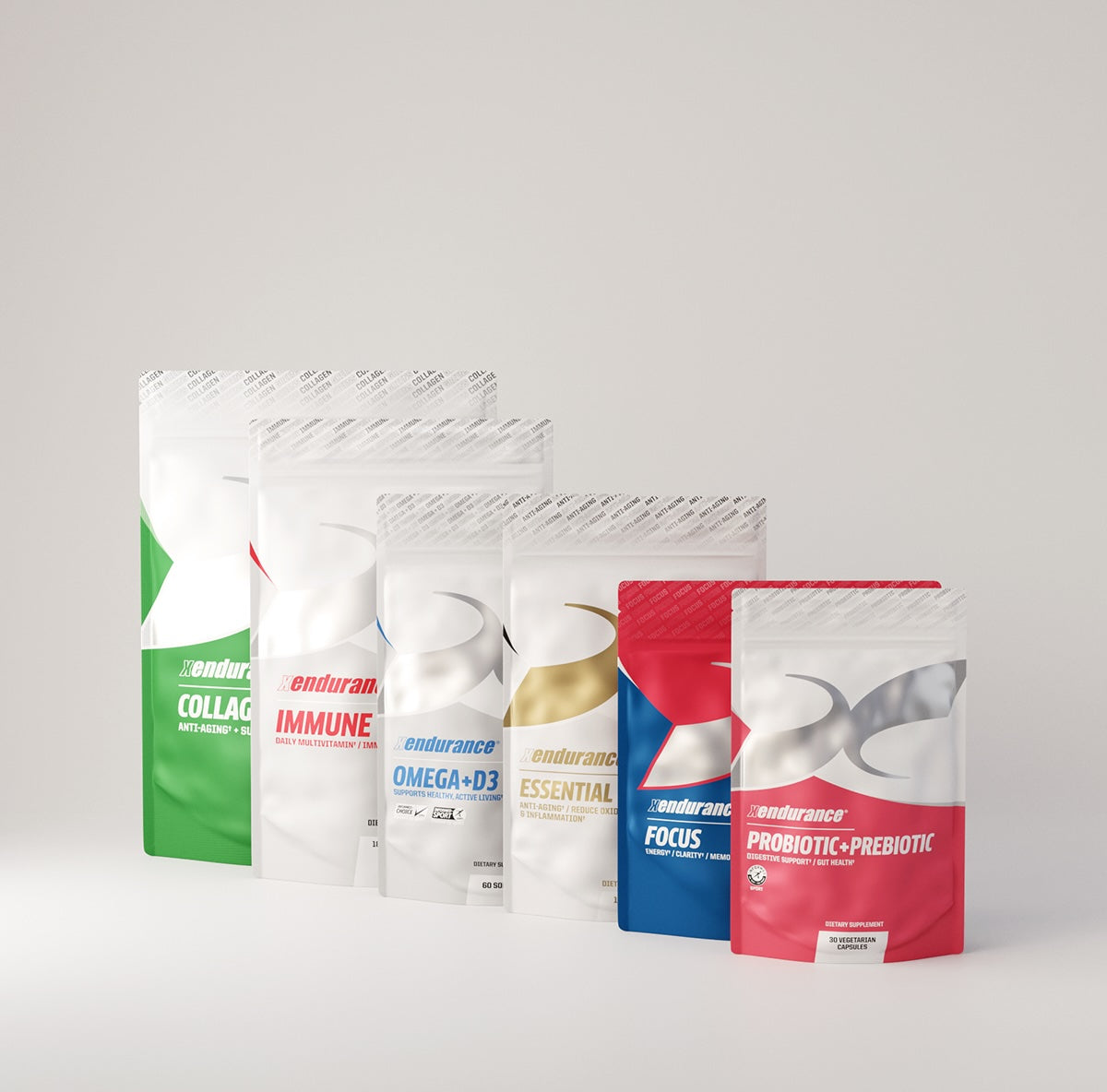
Xendurance Collagen+Greens is built for that daily habit. One serving delivers 16 grams of grass-fed collagen peptides (Type I and Type III), plus a blend of organic superfood greens—moringa, kale, spirulina, chlorella, acai, and goji. The product is naturally flavored, gluten-free, and dairy-free, and is Informed Sport certified. Suggested use is daily; the brand also positions it as a snack or post-workout shake. Product directions often add the useful line athletes actually need: once daily, even on rest days.
Sixteen grams sits right next to the 15 g dose range discussed for collagen-synthesis work and above the 5–10 g daily amounts used in several joint-pain athlete trials summarized above. Type I and Type III are the forms the product page highlights for connective tissue, bone, tendon, skin, and related structures. Type I is the dominant collagen in tendon, ligament, bone, and skin. Type III is common in more elastic connective tissues. That is a connective-tissue formula, not a hypertrophy formula.
What Collagen+Greens is not: a complete replacement for whey or other high-leucine proteins when hypertrophy or muscle protein synthesis is the priority. The systematic review is explicit that collagen underperforms those proteins for MPS. Keep your protein strategy. Add collagen for the connective-tissue lane.
The greens side is a convenience layer, not the mechanism behind the joint trials. Antioxidant-rich plants do not replace the peptide dose. They do make a daily scoop easier to justify on rest days, when an athlete might skip a “recovery-only” product but will still drink a morning shake.
A simple weekly template athletes can actually follow
- Every morning (or the same time daily): 1 scoop Xendurance Collagen+Greens in 200–250 ml water, or blended with berries.
- Hard lower-body / long-run / high-impact days: shift that scoop to about 60 minutes pre-session when the schedule allows. A small amount of vitamin C in the mix is consistent with the gelatin-plus-loading research.
- After the session: prioritize carbohydrate and a complete protein source for muscle glycogen and muscle protein synthesis. Collagen can still be in the mix later in the day if you already used it pre-session, but it should not crowd out total protein needs.
- Rest and easy days: take the scoop anyway. That is how the 12- to 24-week joint trials were run.
- Give it time: think in months, not one race week—matching how the athlete joint trials were designed.
Athletes who already use a separate collagen product can apply the same rules: hit 10–15 g most days, lock the habit to a clock time, and slide the serving earlier on loading days. The product choice matters less than the weekly dose and the number of weeks you actually take it.
What collagen will not do
A fair article should say the quiet parts. Collagen will not rebuild a torn tendon by itself. It will not replace strength work, cadence changes, or a smarter HYROX station progression. It is not anti-inflammatory medicine. Effects in the better trials are modest: less activity-related pain, better function scores, higher synthesis markers—not a guarantee you will feel new on week two.
It is also not a license to ignore total protein. Endurance athletes in a deficit, masters athletes, and hybrid athletes stacking running with lifting still need enough essential amino acids from food or a complete protein powder. Collagen is rich in glycine and proline and relatively low in leucine. Use it as a specialist tool.
Daily habit first, timing second
For endurance and hybrid athletes, collagen works best as a daily connective-tissue habit. Using it only after the hardest sessions is unlikely to match the protocols that reduced activity-related joint pain in research. Optional pre-session timing—about 60 minutes before loading—is a smart upgrade on key days, not a reason to skip rest-day scoops.
A product like Xendurance Collagen+Greens fits that model because the serving size is in the research range, the collagen types match the tissues athletes load, and the brand’s own directions already say daily, including rest days. Take the scoop on the easy days. Move it earlier when the session is going to beat up tendon and joint. Keep your carbs and complete protein after the work. Then give the tissue the same thing the trials gave it: weeks, not one hard Sunday.



コメントを書く
このサイトはhCaptchaによって保護されており、hCaptchaプライバシーポリシーおよび利用規約が適用されます。