



Athletes often underdose joint formulas—here’s why a higher capsule count for the first 30 days, then a maintenance dose, matches how Joint-4 is designed to be used, and how that protocol lines up with the clinical literature on glucosamine, chondroitin, Boswellia, and MSM.
Most endurance and hybrid athletes treat joint support like a vitamin they remember when something already hurts. They grab a bottle that lists glucosamine—or glucosamine plus chondroitin—take whatever is on the front panel for a week, feel nothing dramatic, and quit. That pattern misses two practical details that show up clearly when you read a thoughtfully designed joint formula: what is actually in it, and how the first month of dosing is supposed to work.
Joints are not a single-nutrient problem. Cartilage, connective tissue, and the body’s inflammatory response all sit under the same training load—long runs, sleds, wall balls, heavy squats, repetitive impact. When those tissues feel the miles, a one-ingredient capsule is often the wrong mental model. The more useful question is whether the formula covers the pieces that matter, at doses worth taking, for long enough to evaluate.
What “joint support” is actually trying to do
Cartilage is the cushioning tissue between bones. Glucosamine is an amino sugar involved in building and maintaining that tissue. Chondroitin helps cartilage hold water and retain its shock-absorbing character. Those two are the ingredients most athletes recognize—and for good reason—but they are not the whole conversation.
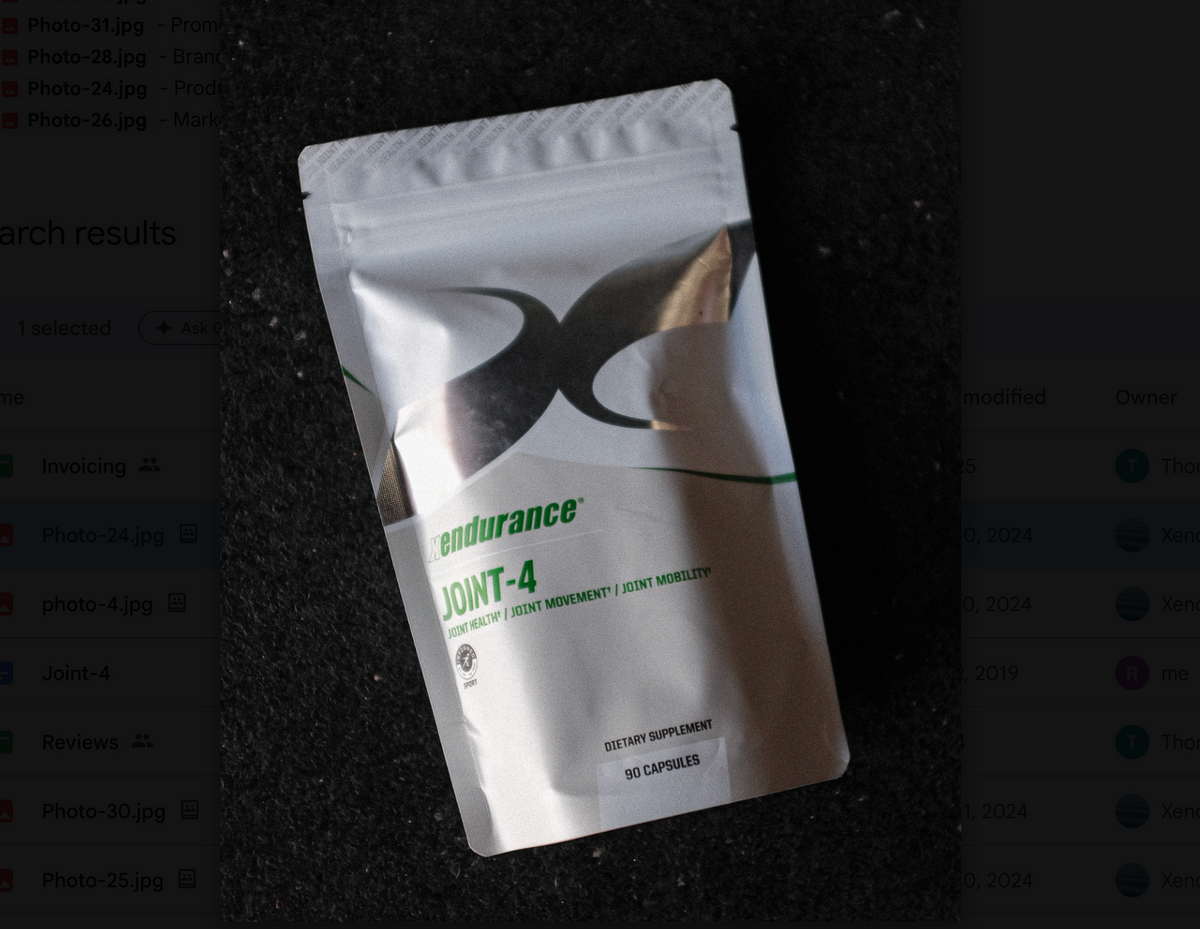
A complete daily formula can also include compounds aimed at the body’s healthy inflammatory response and joint-tissue environment. On the Xendurance Joint-4 label, that means four named ingredients used together at research dosages:
- Glucosamine (HCl) — helps promote healthy cartilage
- Chondroitin (sulfate) — helps maintain joint health
- Boswellia (Boswellia serrata) — supports the body’s healthy inflammatory response
- MSM (methylsulfonylmethane) — promotes healthy joint tissues and a healthy inflammatory response
That combination is the point. Listing glucosamine alone can look impressive on a store shelf. Listing all four—and stating that they are present at research dosages—tells you the formulator was building ongoing joint support, not a single-ingredient marketing claim.
The serving math matters. Public label data for Joint-4 shows, per three capsules: 750 mg glucosamine HCl, 600 mg chondroitin sulfate, 300 mg Boswellia serrata extract, and 750 mg MSM. The first-month protocol of six capsules per day therefore supplies 1,500 mg glucosamine HCl, 1,200 mg chondroitin sulfate, 600 mg Boswellia extract, and 1,500 mg MSM—numbers that sit inside the ranges used in many clinical trials of these ingredients.
Joint-4 has been positioned as all-natural joint support for active younger adults and for athletes in their older years, with a long track record of use. It is Informed Sport certified on the product page. None of that replaces smart training progression, strength work around the hips and trunk, or recovery basics. It is a tool for people whose knees, hips, shoulders, or ankles are absorbing real volume.
What the clinical studies actually say
The evidence is not uniform, and it is honest to say so. Large reviews of oral supplements for osteoarthritis find that some ingredients produce statistically significant changes that may or may not feel large to every person, while others show clearer short-term symptom effects. A 2018 systematic review and meta-analysis in the British Journal of Sports Medicine of 69 randomized trials is a useful map: Boswellia serrata extract showed large, clinically important short-term effects on pain; MSM, glucosamine, and chondroitin showed statistically significant pain improvements whose clinical importance was judged more modest or mixed.
Glucosamine and chondroitin. The landmark NIH-sponsored GAIT trial (Clegg et al., New England Journal of Medicine, 2006) randomized 1,583 people with knee osteoarthritis to 1,500 mg glucosamine HCl, 1,200 mg chondroitin sulfate, both, celecoxib, or placebo for 24 weeks. Overall, the combination was not significantly better than placebo. In the exploratory subgroup with moderate-to-severe baseline pain, however, the combination produced a higher response rate than placebo (79.2% vs. 54.3%). That is one reason combination products keep using the 1,500 / 1,200 mg pair: it is the dose set that large trials actually tested.
A later European trial, MOVES (Hochberg et al., Annals of the Rheumatic Diseases, 2016), compared chondroitin sulfate plus glucosamine hydrochloride with celecoxib in 606 people with painful knee osteoarthritis. After six months, pain reduction was essentially the same in both groups (about a 50% drop in WOMAC pain), and the combination met the trial’s non-inferiority margin. That does not make a capsule a prescription anti-inflammatory. It does show that the research-dose combination can move symptoms in people who already have meaningful joint pain—over months, not days.
Boswellia. Boswellia serrata is the ingredient most consistently associated with faster-feeling changes in stiffness and pain scores. A 2020 systematic review and meta-analysis of seven trials (545 patients) found Boswellia extracts reduced VAS pain and WOMAC pain, stiffness, and function versus control, and the authors recommended a treatment window of at least four weeks. A 2024 meta-analysis of nine RCTs (712 participants) again found significant improvements in VAS and WOMAC subscales. That four-to-eight-week horizon is one reason a 30-day “full dose” window is not an arbitrary marketing number.
MSM. MSM trials are smaller, but several randomized studies report improvements in pain and function over 12 weeks. Kim et al. (Osteoarthritis and Cartilage, 2006) used 3 g twice daily and found significant decreases in WOMAC pain and physical-function impairment versus placebo. Debbi et al. (BMC Complementary and Alternative Medicine, 2011) used 1.125 g three times daily (3.375 g/day) for 12 weeks and reported better WOMAC physical function and total score versus placebo. A 2023 randomized trial in people with only mild knee pain also found improved knee-related quality-of-life scores after 12 weeks of MSM.
Combinations, not isolated bottles. Joint-4 is a four-ingredient product, so combination data is more relevant than any single capsule on a pharmacy shelf. Usha and Naidu (Clinical Drug Investigation, 2004) randomized 118 people with mild-to-moderate osteoarthritis to glucosamine, MSM, both, or placebo for 12 weeks. Each active arm improved versus placebo; the combination reduced pain and swelling more and faster than glucosamine alone. A later randomized trial of MSM plus boswellic acids versus glucosamine sulfate found both approaches improved symptoms over 60 days, with a trend favoring the MSM–boswellia pairing at follow-up. An Indonesian double-blind trial in grade I–II knee OA likewise reported that adding MSM to glucosamine plus chondroitin improved WOMAC and VAS at 12 weeks compared with glucosamine–chondroitin alone.
Taken together, the literature does not promise that every runner will feel a switch flip on day five. It does support a different expectation: multi-ingredient formulas at research-range doses tend to be evaluated over four to twelve weeks, combination products sometimes outperform single agents, and Boswellia is the piece most often associated with earlier changes in inflammatory-symptom scores.
Why the first 30 days use more capsules
Here is the usage detail most athletes skip.
For the first 30 days, the Joint-4 protocol is 3 capsules with the morning meal and 3 capsules with the evening meal—6 capsules per day. After that first month, the maintenance dose is 3 capsules daily with either the morning or evening meal. If joint discomfort returns at the lower dose, the guidance is to return to 6 capsules per day. The product FAQ is explicit that people dealing with joint discomfort, aches, or soreness should give it one to two full months at the recommended 6 capsules per day before judging the result.
That is a loading-then-maintenance pattern, not a forever megadose. The higher initial capsule count is how the product is designed to be evaluated: give the full research-dose combination consistent daily exposure for a month, then step down if things feel managed.
That timeline matches how these ingredients have been studied. Glucosamine and chondroitin trials typically run 8–24 weeks before primary outcomes are read. MSM studies commonly use 12 weeks. Boswellia analyses often treat four weeks as a minimum window. Cartilage and peri-articular tissue do not announce adaptation the way caffeine does. You are not looking for a 20-minute “lock-in.” You are looking for whether morning stiffness, post-run joint ache, or the nagging feeling after heavy lower-body days changes across weeks of consistent intake—while you keep training intelligently.
If you only ever take the maintenance count from day one, or you sample the product for five days during a hard block and decide it “does nothing,” you have not followed the protocol the formula was written for, and you have not given the evidence base a fair test.
How to use it in a real training week
Practical application for runners, HYROX athletes, and hybrid lifters:
- Start on a normal training week, not race week. You want a clean read on how your joints feel across easy days and hard days.
- Hit the full first-month dose. Three capsules with breakfast (or your morning meal), three with dinner. Pair with food as directed.
- Keep the rest of the system boring and strong. Progressive strength for the tissues that stabilize the joint, gradual running or station volume, sleep, and hydration still do the heavy lifting. A joint formula supports the environment; it does not erase poor load management.
- Reassess at ~30 days. If discomfort is well managed, step to 3 capsules daily. If it creeps back, return to 6. That titration is built into the product guidance.
- Give it enough runway. One to two months at the higher dose is the product’s own recommendation for people who already feel joint stress. Patience is part of the method.
Athletes who already use collagen peptides for connective-tissue amino acids sometimes ask whether that replaces a glucosamine-based joint formula. Different tools. Collagen peptides supply amino acids used in collagen synthesis; Joint-4 is a capsule formula built around glucosamine, chondroitin, Boswellia, and MSM. Some athletes use both for different jobs. Neither is a substitute for fixing training errors.
Label literacy beats bottle hype
The same habit that helps when you read a probiotic or a mineral label helps here. Turn the pouch around and ask:
- Are the ingredients fully named (including forms such as glucosamine HCl and chondroitin sulfate)?
- Is Boswellia listed as Boswellia serrata, not a vague “joint blend”?
- Does the brand state research dosages rather than hiding amounts in a proprietary blend?
- Is there a clear loading and maintenance protocol, or only a vague “take daily”?
- For competitive athletes, is the product third-party tested for banned substances (Joint-4’s page states Informed Sport certification)?
Those questions separate a serious joint tool from a hope-in-a-bottle label.
The protocol, not the bottle
You do not need a loading phase for every supplement. Creatine timing debates, sleep formulas, and daily electrolytes each follow different rules. Joint support is one category where the published protocol often does start higher for a defined window, then steps down—and where the clinical literature on these four ingredients is measured in weeks and months, not workouts.
If your training loads the same joints week after week—and especially if you are a master’s athlete or a hybrid athlete stacking impact with heavy lifts—read the dosing section before you judge the category. For Joint-4, that means four ingredients at research dosages, 6 capsules a day for the first 30 days, then 3 a day unless discomfort says otherwise. Use it as intended, keep training smart, and treat the capsules as support for tissues that already work hard for you—not as a shortcut around recovery.

Leave a comment
This site is protected by hCaptcha and the hCaptcha Privacy Policy and Terms of Service apply.