



Caffeine is one of the most studied legal performance aids in sport. Most endurance athletes already consume it daily through coffee, tea, or energy drinks, yet questions remain about whether it truly helps on race day, how much is useful, and why responses vary so widely. Some athletes report sharper focus and better pacing; others experience only jitteriness, an elevated heart rate, or no noticeable benefit. The research provides clearer answers than individual anecdotes, while still highlighting real individual differences.
What the Evidence Shows
The International Society of Sports Nutrition (ISSN) reviewed the body of research in its 2021 position stand on caffeine and exercise performance. The authors concluded that caffeine acutely improves many kinds of exercise performance “in many but not all studies.” Aerobic endurance stood out as the modality with the most consistent moderate-to-large benefit.
A 2018 systematic review and meta-analysis pooled 46 randomized, placebo-controlled studies of endurance time trials. Compared with placebo, caffeine improved mean power output by approximately 3.0% and time-trial completion time by about 2.2%. The authors described this as a “small but evident” effect at moderate doses and noted that a 2% improvement can influence placings when athletes are separated by small margins.
An umbrella review of 21 published meta-analyses reached a similar conclusion. Caffeine was ergogenic for aerobic endurance, muscle strength, muscle endurance, and power, with generally larger effects in aerobic than anaerobic exercise. The reviewers also flagged an important limitation: most underlying studies were conducted in young men, so more data are needed in women and in middle-aged and older athletes.
These findings align with practical race contexts. A 2–3% improvement in a well-matched field can separate podium places from mid-pack finishes in events ranging from 10 km runs to longer cycling or triathlon time trials. The benefit is not automatic or universal, but it is reproducible across a large number of controlled studies when dosing and timing are appropriate.
How Much Caffeine?
Researchers typically dose caffeine relative to body weight rather than by the number of cups. According to the ISSN position stand, caffeine has consistently improved performance at 3–6 mg per kilogram of body mass. The minimum effective dose is less clear but may be as low as 2 mg/kg. Very high doses (around 9 mg/kg) produce a high rate of side effects without clear additional benefit and are not necessary.
For a 70 kg (154 lb) athlete, 3 mg/kg equals 210 mg of caffeine—roughly the amount in a large coffee or a couple of caffeinated gels, depending on the products. A lighter 55 kg athlete would use about 165 mg at the same dose per kilogram, while an 85 kg athlete would use about 255 mg. These are moderate amounts that sit well below the high-dose range associated with more frequent adverse effects such as anxiety, gastrointestinal distress, or elevated heart rate.
Habitual intake matters for interpretation of these numbers. An athlete who routinely consumes 300–400 mg per day may experience a different response than someone who rarely uses caffeine. The performance studies generally still show benefit even in habitual users, but individual testing remains the most reliable guide.
When to Take It
The most common timing in research protocols is approximately 60 minutes before the start of exercise. This allows plasma caffeine levels to rise and peak during the early portion of the effort. The ISSN notes that optimal timing can depend on the source: caffeinated gum, for example, is absorbed more rapidly through the oral mucosa and may require less lead time than capsules or beverages. Energy gels, chews, energy drinks, and caffeinated pre-workout supplements have also been shown to improve performance in controlled settings.
For longer events, some athletes split the dose—taking part before the start and the remainder during the race through gels or chews. This approach keeps caffeine available later in the effort without relying solely on a single pre-race intake. Because total daily caffeine still needs to stay within the moderate range that research supports, athletes should add every source (coffee, gels, chews, pre-workouts, and any other products) when planning the strategy.
Why Some Athletes Don’t Respond
Caffeine does not affect everyone the same way. The ISSN links part of the variation to genetic differences in caffeine metabolism, habitual intake, and individual physical and psychological responses.
One randomized, double-blind trial tested 101 competitive male athletes in a 10 km cycling time trial using 0, 2, or 4 mg/kg of caffeine. Overall, 4 mg/kg reduced cycling time by 3%. Results differed by CYP1A2 genotype, the gene that codes for the primary enzyme that metabolizes caffeine:
- Athletes with the AA genotype improved by 4.8% at 2 mg/kg and 6.8% at 4 mg/kg.
- Athletes with the AC genotype showed no clear effect.
- Athletes with the CC genotype were 13.7% slower at 4 mg/kg.
The practical takeaway is not that every athlete needs genetic testing. It is that personal response can diverge substantially from the group average. If a given dose produces anxiety, disrupts sleep the night before a hard session, or simply fails to improve perceived effort or split times, that feedback is useful. Sleep disruption and anxiety are among the individual effects the ISSN highlights. Athletes who train or race in the evening should weigh these factors carefully, because caffeine’s half-life can extend its influence well into the night for some people.
Other variables also contribute. Women may respond differently across the menstrual cycle in some studies, though data remain limited. Training status, event duration, environmental conditions, and even expectations can modulate the experience. The most reliable filter is still controlled self-testing rather than reliance on population averages alone.
Practical Steps for Race Day
- Test the planned dose and timing in training or a tune-up race. Never introduce a new caffeine strategy for the first time on race day.
- Start at the lower end of the effective range (around 2–3 mg/kg) if you are uncertain of your response. Some athletes obtain clear benefit at these moderate amounts.
- Time intake so that levels are elevated during the key portions of the effort. Sixty minutes pre-start is the most studied window; faster-absorbing formats such as gum may need less lead time.
- Account for every source. Coffee at breakfast, a caffeinated gel at the start, and additional chews later all contribute to the total.
- Protect sleep. If an evening session or late race is planned, consider whether the dose will still be circulating at bedtime and whether that trade-off is worthwhile.
- Note any side effects. Elevated heart rate, gastrointestinal discomfort, or mental fog are signals to adjust the dose or skip caffeine for that effort.
These steps keep the strategy inside the range supported by the research while respecting individual variation.
Where Xendurance Fits
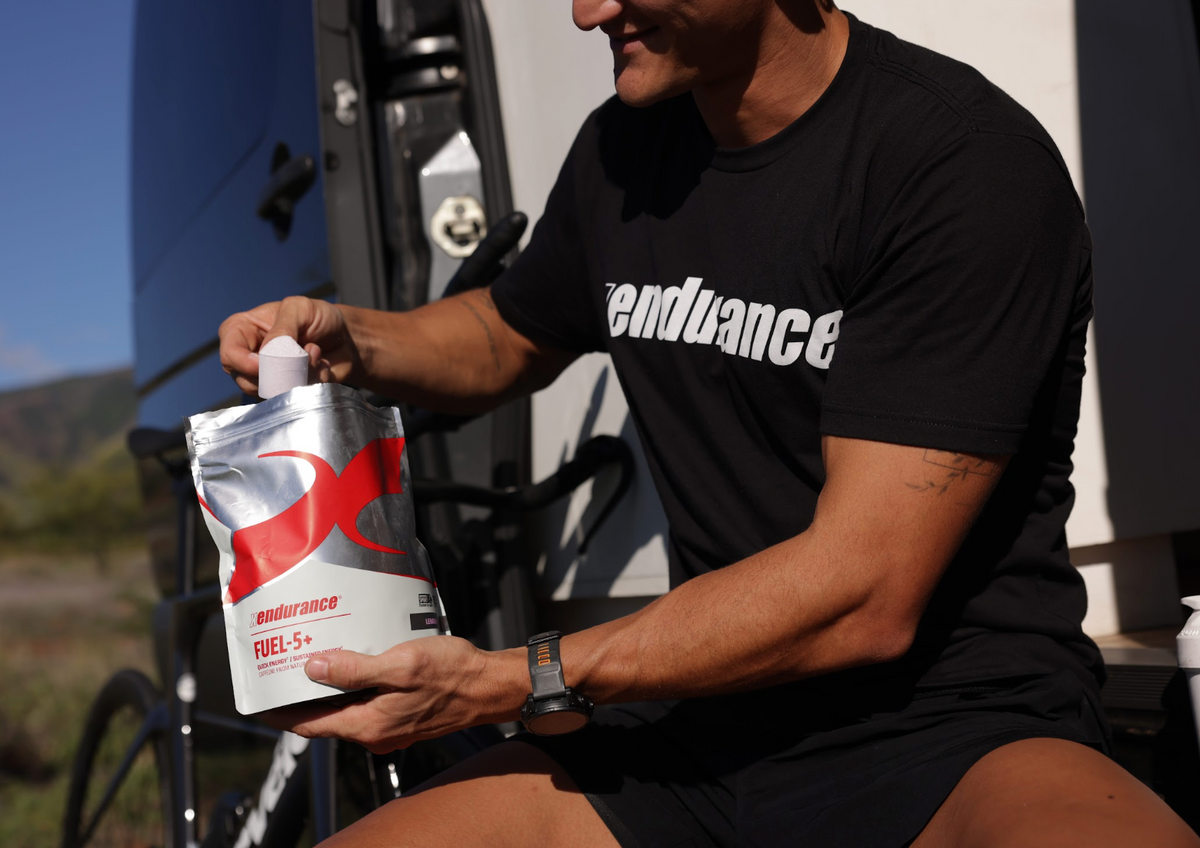
Athletes who want a modest amount of caffeine packaged with carbohydrates before a session have options within existing product lines. Fuel-5+ is Xendurance’s pre-workout carbohydrate blend. Its product page describes a combination of organic sweet potato and four carbohydrate sources together with 45 mg (1 scoop) of natural caffeine from green tea extract, plus electrolytes and vitamins B6 and B12. For someone targeting a total intake in the 2–3 mg/kg range, the 45 mg contribution is small enough to leave room for other sources or to serve as a light pre-session dose on its own. The original Fuel-5 provides the same carbohydrate blend without listed caffeine, offering a straightforward alternative for athletes who prefer to keep caffeine separate or omit it entirely.
Because responses differ, either product is best evaluated in training rather than adopted solely on the basis of average study results. The 45 mg amount in Fuel-5+ should be added to the rest of the day’s caffeine when calculating total intake.
Frequently Asked Questions
Does caffeine improve endurance performance?
For most athletes in the studies reviewed, yes. A meta-analysis of 46 placebo-controlled endurance trials reported roughly a 3% gain in power output and about a 2% faster time-trial time. The effect is consistent enough to be considered practically meaningful in close competitions, though not every individual experiences it.
How much caffeine should I take before a race?
Research supports 3–6 mg per kilogram of body weight, and possibly as little as 2 mg/kg. Very high doses near 9 mg/kg mainly increase side effects without clear extra benefit.
When should I take caffeine before exercise?
About 60 minutes before the start is the most common and studied timing. Faster-acting formats such as gum may require less lead time.
Why doesn’t caffeine work for me?
Genetics (including CYP1A2 variants), habitual intake, and individual sensitivity all influence the response. In one controlled trial, athletes with the CC variant of CYP1A2 performed worse at 4 mg/kg. Personal testing remains the most useful guide.
Do I need to quit coffee before a race to feel the effect?
Caffeine has improved performance in both trained and untrained participants. Habitual intake can influence individual response, so the practical recommendation is to test the race-day routine—including usual coffee—in training rather than making abrupt changes.
The Edge Is Personal
Caffeine remains one of the few legal edges that can still move the needle in a close race, but the research also shows it is not a universal switch. The same 3–6 mg per kilogram that sharpens one athlete’s power and focus can leave another jittery, sleepless, or simply unchanged. The real advantage comes from treating the numbers as a starting point, then testing your own dose, timing, and total intake in training until the effect is clear and repeatable. On race day the difference between a useful tool and an unnecessary risk is rarely the caffeine itself; it is knowing, from experience, exactly how your body answers it.
Sources
1. Guest NS, et al. International Society of Sports Nutrition position stand: caffeine and exercise performance. J Int Soc Sports Nutr. 2021;18(1):1. https://pubmed.ncbi.nlm.nih.gov/33388079/
2. Southward K, Rutherfurd-Markwick KJ, Ali A. The effect of acute caffeine ingestion on endurance performance: a systematic review and meta-analysis. Sports Med. 2018;48(8):1913-1928. https://pubmed.ncbi.nlm.nih.gov/29876876/
3. Grgic J, et al. Wake up and smell the coffee: caffeine supplementation and exercise performance, an umbrella review of 21 published meta-analyses. Br J Sports Med. 2020;54(11):681-688. https://pubmed.ncbi.nlm.nih.gov/30926628/
4. Guest N, et al. Caffeine, CYP1A2 genotype, and endurance performance in athletes. Med Sci Sports Exerc. 2018;50(8):1570-1578. https://pubmed.ncbi.nlm.nih.gov/29509641/

コメントを書く
このサイトはhCaptchaによって保護されており、hCaptchaプライバシーポリシーおよび利用規約が適用されます。