



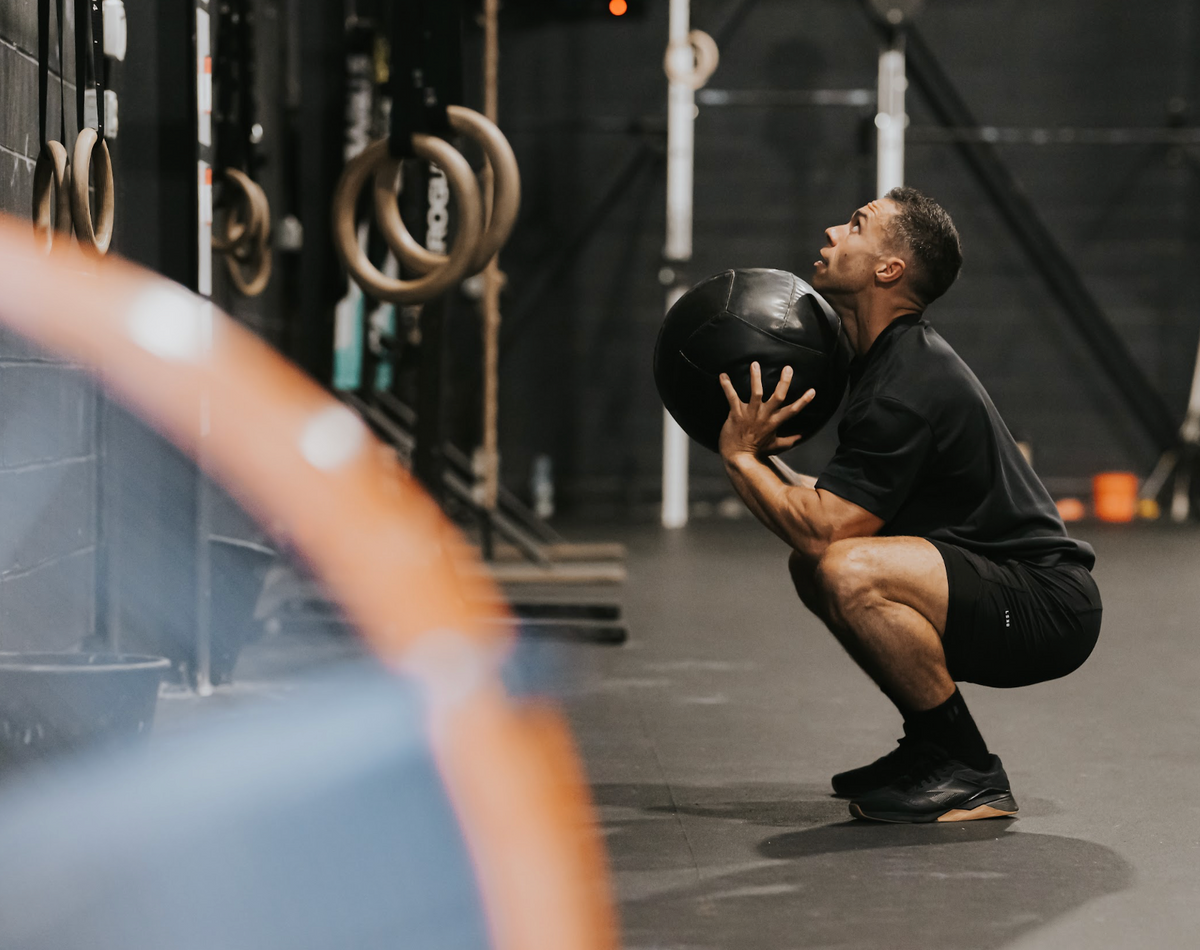
If you train for HYROX, mix CrossFit-style sessions with dedicated lifting, or simply lift and run in the same week, you have almost certainly heard the warning: cardio kills your gains. Coaches call this the interference effect—the idea that endurance work blunts the strength, power, and muscle you build from resistance training. The effect is real. It is also smaller, more specific, and far more manageable than the gym myth suggests. Once you understand what actually drives it, you can structure your week so both qualities improve instead of fighting each other.
Hybrid athletes live in the middle of two classic training worlds. Strength work pushes the body toward bigger, stronger muscle fibers and better force production. Endurance work pushes it toward more mitochondria, better oxygen delivery, and fatigue resistance. At the molecular level, these signals can compete—endurance-related pathways can dampen the anabolic signals that drive strength and size adaptations. The practical question is not whether interference exists, but how large it is, who feels it most, and which simple training choices shrink it to a manageable level.
What the Research Actually Shows.
The clearest modern summary comes from a 2022 systematic review and meta-analysis published in Sports Medicine. Researchers pooled 43 studies of healthy adults who performed supervised concurrent training for at least four weeks. Compared with strength training alone, adding aerobic work did not produce a statistically significant reduction in gains in maximal strength or muscle size. Explosive strength—the ability to produce force quickly—was the quality that suffered. The blunting was clearest when aerobic and strength work occurred in the same session.
The authors concluded that concurrent aerobic and strength training “does not compromise muscle hypertrophy and maximal strength development,” but that explosive strength gains “may be attenuated, especially when aerobic and strength training are performed in the same session.” For hybrid athletes, this is encouraging news. You can get stronger and add muscle while you build your engine. The part that needs deliberate protection is power: jumps, short sprints, heavy sled pushes, wall-ball bursts, and the first few high-quality reps of an Olympic lift. Those efforts suffer more when residual fatigue from endurance work is still present.
Training Status Changes the Picture.
Interference is not one-size-fits-all. A 2021 meta-analysis of 27 studies examined lower-body one-rep-max strength (leg press and squat). Concurrent training reduced 1RM gains in trained individuals, but not in moderately trained or untrained people. In the trained group, the negative effect appeared mainly when lifting and endurance work happened in the same session. When the two were separated into different sessions, the difference was no longer significant.
The practical takeaway is straightforward: the more experienced you are, the more your session structure matters. A relative beginner can often get away with messier scheduling because their adaptive window is wide. A well-trained hybrid athlete who already has solid strength and a decent aerobic base has less room for error. For that person, back-to-back sessions or poorly ordered days are more likely to blunt progress.
Does Order Matter? Lift First or Condition First?
When both qualities must share a session, order matters for lower-body strength. A 2018 meta-analysis of 10 studies compared the two sequences across programs lasting five weeks or longer. Performing resistance training before endurance work produced better lower-body dynamic strength gains than the reverse order, with a weighted mean difference of roughly 6.9 percent. Order made no significant difference to lower-body muscle size, VO2max, or body-fat percentage.
In practice, this means that if leg strength or power is the priority of the day, lift first and do the run, row, or erg work afterward. The reverse order is more acceptable when the day’s main goal is aerobic capacity, and the lifting is lighter or upper-body focused. Many hybrid athletes instinctively do the opposite—finishing a long run and then trying to squat heavy—because it feels efficient. The data suggest that efficiency comes at a cost to strength progress.
How Much Space Between Sessions?
Recovery time between sessions is another reliable lever. In a seven-week randomized study, 58 amateur rugby players were assigned to groups that performed strength and aerobic sessions with 0, 6, or 24 hours of recovery between them. Strength always came first. Gains in bench-press and half-squat max strength were smaller when the sessions were back-to-back (0 hours) than when athletes had 6 or 24 hours of recovery. VO2peak improved more with 24 hours of separation than with 0 or 6 hours. The authors advised against scheduling the two qualities less than six hours apart if the goal is the full adaptive response.
This finding lines up with the 2022 meta-analysis: the reduction in explosive-strength gains was clearer when both modes were performed in the same session than when sessions were separated by at least three hours. For most hybrid athletes, the practical rule is simple—separate the key strength session and the key endurance session by at least six hours, or place them on different days when possible. Same-day double sessions can still work, but they should not be the default for the qualities you care about most.
What Kind of Cardio, and How Much?
An earlier, widely cited 2012 meta-analysis of 21 studies found that running, but not cycling, combined with resistance training significantly reduced both hypertrophy and strength gains. It also reported that higher frequency and longer endurance sessions were linked to smaller strength, size, and power gains. The newer 2022 analysis did not find a significant cycling-versus-running difference, so modality should be treated as a “maybe” rather than a hard rule. Endurance volume, however, remains a consistent lever. Longer sessions and more frequent sessions tend to produce more interference.
For hybrid athletes, this means that a hard 90-minute run the day before heavy squats is more likely to blunt progress than a 30-minute easy spin or a short, high-intensity interval session. Total weekly endurance volume matters more than any single modality. During blocks where strength or power is the priority, keep the longest and hardest endurance sessions farther away from the heaviest lifting days.
A Practical Hybrid Week Framework.
These recommendations are coaching applications of the findings above, not rigid rules from any single study:
- When lower-body strength or power is the day’s priority, lift first and condition second.
- Separate key strength and conditioning sessions by at least six hours when possible, or place them on different days.
- Protect explosive work. Schedule jumps, sprints, Olympic lifts, and high-quality power efforts when you are fresh, not after a long run or hard conditioning piece.
- Watch total endurance volume during strength-focused blocks. Higher volume and frequency are linked to greater interference.
- If you are well trained, session structure matters more for you than it does for a beginner.
A simple example week for a hybrid athlete who wants to protect strength while still building an engine might look like this: Monday—heavy lower-body strength (squat, hinge, single-leg work) followed by short, low-volume conditioning later in the day or the next morning. Tuesday—easy aerobic work or upper-body strength. Wednesday—power and explosive work when fresh, then short intervals. Thursday—moderate upper-body or full-body strength. Friday—longer aerobic session or HYROX-style race-pace work, kept away from the heaviest lower-body day. Weekend—recovery, skill work, or a light mixed session. The exact days can shift; the principles of priority, order, and spacing stay the same.
Where Supplements Fit:
Training structure does the heavy lifting. No supplement removes the interference effect. For athletes who are stacking lifting and conditioning, however, creatine monohydrate remains one of the most studied tools for supporting strength, power, and recovery. Xendurance’s Creatine-JB is formulated with Creapure® creatine monohydrate. The brand states that it “promotes increased energy and strength” and “supports protein synthesis and muscle growth, power, and recovery.” Think of it as one useful tool that sits alongside a smart weekly plan, not a replacement for one. Consistent sleep, adequate protein, and deliberate session spacing will still move the needle more than any single product.
Frequently Asked Questions:
Does cardio kill muscle gains?
Not in most people. A 43-study meta-analysis found no significant loss of muscle size or maximal strength from adding aerobic training. Explosive strength gains were the quality that was blunted.
Should I lift or run first?
For lower-body strength, lifting first produced better strength gains in a meta-analysis of 10 studies. If the day’s priority is aerobic capacity, the reverse order is usually fine.
How far apart should strength and cardio be?
One randomized study suggests at least six hours, and more separation was better for aerobic gains. Separate sessions also appear to reduce interference in trained lifters.
Is running worse than cycling for interference?
An older meta-analysis said yes. A newer one found no significant difference. The evidence is mixed; volume and timing matter more than the specific machine or surface.
Does the interference effect disappear if I just train harder?
No. In trained athletes, the effect is more noticeable, and poor session structure makes it worse. Better organization usually beats simply adding more volume.
Interference Effect: Build Strength + Endurance as a Hybrid Athlete
You can build strength and endurance at the same time. The interference effect is real, but it is largely confined to explosive strength, more pronounced in well-trained athletes, and heavily influenced by order, spacing, and total endurance volume. Lift first when strength is the priority, separate key sessions by several hours or different days, protect your fresh power work, and keep endurance volume in check during strength blocks. Do those things consistently, and the hybrid athlete’s double life becomes far more productive than the old gym myth suggests.
Sources
Schumann M, et al. Compatibility of Concurrent Aerobic and Strength Training for Skeletal Muscle Size and Function: An Updated Systematic Review and Meta-Analysis. Sports Med. 2022;52(3):601-612. https://pubmed.ncbi.nlm.nih.gov/34757594/
Petré H, et al. Development of Maximal Dynamic Strength During Concurrent Resistance and Endurance Training in Untrained, Moderately Trained, and Trained Individuals: A Systematic Review and Meta-analysis. Sports Med. 2021;51(5):991-1010. https://pubmed.ncbi.nlm.nih.gov/33751469/
Eddens L, et al. The Role of Intra-Session Exercise Sequence in the Interference Effect: A Systematic Review with Meta-Analysis. Sports Med. 2018;48(1):177-188. https://pubmed.ncbi.nlm.nih.gov/28917030/
Robineau J, et al. Specific Training Effects of Concurrent Aerobic and Strength Exercises Depend on Recovery Duration. J Strength Cond Res. 2016;30(3):672-83. https://pubmed.ncbi.nlm.nih.gov/25546450/
Wilson JM, et al. Concurrent training: a meta-analysis examining interference of aerobic and resistance exercises. J Strength Cond Res. 2012;26(8):2293-307. https://pubmed.ncbi.nlm.nih.gov/22002517/

コメントを書く
このサイトはhCaptchaによって保護されており、hCaptchaプライバシーポリシーおよび利用規約が適用されます。