




Endurance athletes spend more time outside than almost anyone. Long runs before work. Saturday rides that eat the morning. Track sessions under a high sun. If vitamin D were only a sunshine story, this group should be the last to run low.
They are not.
Across sports, low vitamin D shows up often enough that “I train outdoors” is not a lab result. Indoor winter blocks, dawn starts, sunscreen, long sleeves, dark kits, and latitudes far from the equator all cut the UVB that skin uses to make vitamin D. The useful question is narrower than the marketing version. Do endurance athletes need to check vitamin D status—or only worry once bloodwork already shows a deficit?
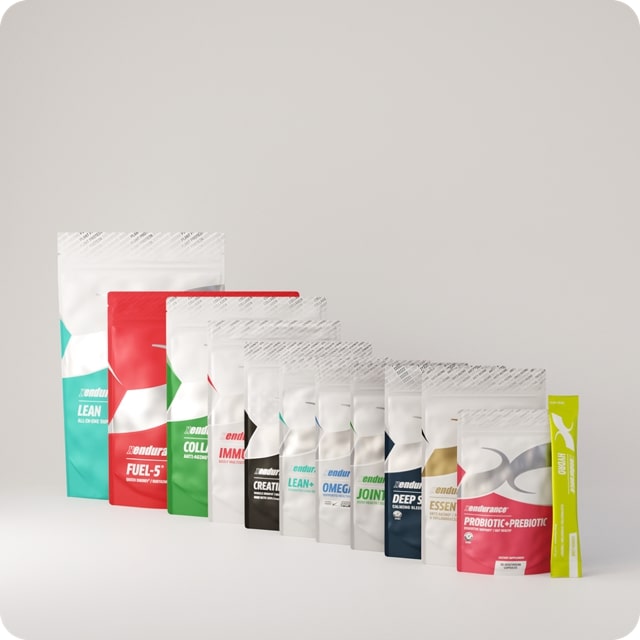
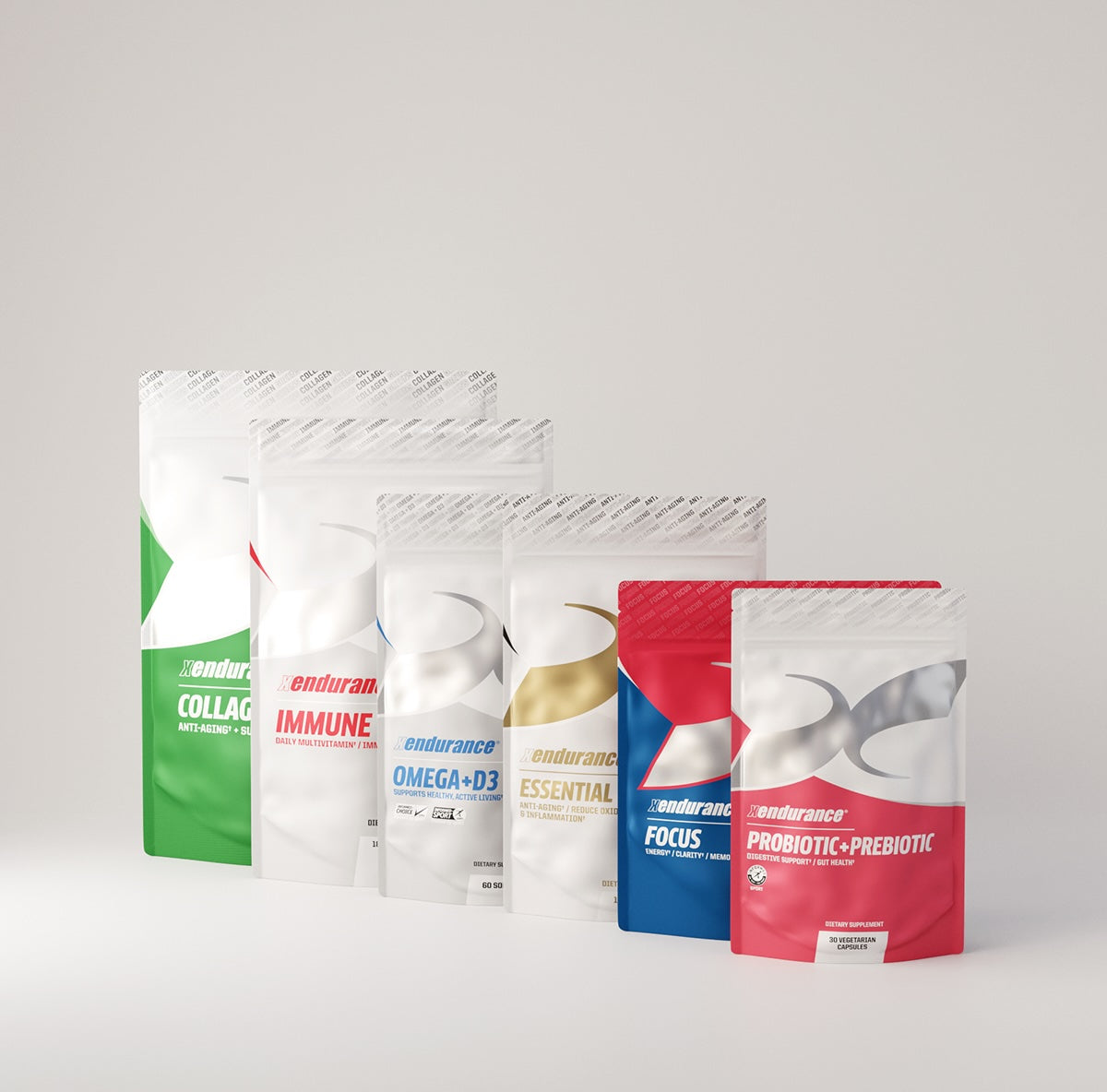
Xendurance Omega+D3 sits in that conversation as a practical daily option, not as a performance shortcut. It is a two-in-one capsule: 1,000 mg of EPA/DHA omega-3s in triglyceride form, plus 4,000 IU of vitamin D3. The product positions vitamin D for calcium and phosphorus absorption, immune support, bone health, and mood, and lists the formula as Informed Sport Certified.* Suggested use is one capsule with the morning meal and one with the evening meal. That is a convenient stack if a clinician agrees a daily D3 dose fits your status. It is not a reason to skip the blood test.
Status first. Supplement with a reason.
The outdoor-athlete paradox
Vitamin D is not a stimulant, and it is not a gel. Skin makes most of it when UVB hits 7-dehydrocholesterol. Diet contributes a little—fatty fish, fortified foods, a few mushrooms—but food alone rarely closes a real gap. Anything that blocks UVB lowers production: winter sun angle, early sessions that finish before useful UV arrives, glass (which blocks UVB), sunscreen, clothing, and higher latitude.
Endurance culture stacks several of those at once. Base season is often the darkest months. Many athletes train before sunrise so the day job still happens. Road and trail athletes cover skin for heat, sun damage, or team kit. Triathletes and cyclists log huge outdoor hours and still spend winter on the trainer. Hyrox and indoor track athletes can go weeks with almost no midday sun. Mileage does not equal a sufficient 25-hydroxyvitamin D level. The assay does.
How common is low vitamin D in athletes?
Farrokhyar and colleagues pooled 23 studies and 2,313 athletes and found vitamin D inadequacy in about 56 percent (range 44–67 percent). Risk was higher in winter and spring, higher in indoor sports, and—after a Middle East outlier was set aside—higher above about 40 degrees north. The authors’ conclusion was blunt: regular investigation of vitamin D status, and supplementation when needed, matters if the goal is healthy athletes (Farrokhyar et al., 2015).
A later narrative review reached the same pattern from a different direction. Suboptimal levels are frequent across sports and seasons. Vitamin D’s roles extend past bone into muscle function, immune defense, and cardiopulmonary physiology that athletes actually use (de la Puente Yagüe et al., 2020). That is not a claim that every slow Tuesday is a vitamin D problem. It is a claim that “I ride outside” is a weak screen.
For endurance athletes, the practical translation is simple. A winter base in the northern half of the United States, a dawn-only schedule, heavy sunscreen, or a mostly indoor race calendar is enough reason to test. Waiting for a stress fracture, a flat month, or a string of colds is a late screen.
What supplementation actually changes
The performance literature is real and uneven. Wyatt and colleagues systematically reviewed randomized, placebo-controlled trials longer than two weeks in elite and organized-sport athletes—14 trials, 482 athletes. Of three trials that measured aerobic capacity, two reported greater improvements in VO2max or PWC-170 with supplementation. Strength and power improved in five of seven studies that measured them. Sprint results were mostly null. The authors judged the clearest potential in aerobic endurance, anaerobic power, and strength, and argued that winter supplementation deserves consideration where UVB is limited (Wyatt et al., 2024).
Read that carefully. Heterogeneous trials, mixed baselines, no blanket ergogenic effect for every athlete who already sits in a healthy range. The signal is strongest when status is the thing being corrected. Chasing a personal record with mega-doses on top of a sufficient 25(OH)D is poorly supported.
Recovery data split the same way. Owens and colleagues randomized vitamin D–insufficient men to 4,000 IU of D3 daily or placebo for six weeks, then hit them with a high-volume eccentric protocol. The supplemented group recovered peak torque better at 48 hours and at seven days (Owens et al., 2015). That dose and that population matter: insufficient men, 4,000 IU, force recovery after muscle damage—not a universal anti-soreness pill.
A separate meta-analysis looked at the blood markers people often treat as proof of “less damage”: creatine kinase, lactate dehydrogenase, and myoglobin. Pooled, vitamin D did not reliably lower them (Bello et al., 2021). Force can return faster in deficient athletes without those enzymes telling a clean story.
Winter, illness, and the endurance calendar
He and colleagues followed 225 endurance athletes across a 16-week winter training block. At the start, 38 percent were inadequate or deficient. By the end, 55 percent were. Athletes who began deficient—25(OH)D under 30 nmol/L—had more upper-respiratory symptom days and a heavier symptom burden than athletes in the optimal group, defined in that paper as above 120 nmol/L (He et al., 2013).
That is an association in an observational cohort, not proof that a capsule prevents colds. Illness in winter is also sleep, travel, volume, and the simple fact of breathing hard in dry air around other athletes. Still, the pattern matches what coaches already see: late-winter respiratory junk clusters in the same months when vitamin D status slides. Planning the season as if February will look like July is how athletes get surprised.
Where Omega+D3 actually fits
The athlete literature and the product label meet in a few narrow places.
Correcting low 25(OH)D is the main use-case in the trials above. Omega+D3 includes 4,000 IU of vitamin D3—the same daily dose Owens used in insufficient men. Daily oral D3 is the route those studies used. The label splits the formula as one capsule with breakfast and one with dinner. Vitamin D is fat-soluble, and the formula pairs it with triglyceride-form EPA and DHA, taken with meals, which is the absorption context it emphasizes. Bone and mineral—calcium and phosphorus retention, bone health—is the classical vitamin D role, not a race-day claim. Immune and mood language is structure–function language, consistent with how vitamin D is discussed in reviews, and it is not a cold-prevention claim.* Informed Sport certification is a batch-testing point for athletes who compete under anti-doping rules.*
What the Omega+D3 product page does not claim, and what this piece will not invent: a target serum level, a promise that every athlete is deficient, a VO2max increase, or fewer respiratory infections. Omega-3s have their own story for heart, brain, and joints. This article is the vitamin D half of the capsule.
A decision rule that respects the evidence
Test when the calendar makes a deficit plausible. Ask for serum 25(OH)D if you train hard through fall and winter, live above roughly 35–40 degrees north, race or train mostly indoors, cover skin aggressively, or rarely see midday sun. Endurance athletes in the Sun Belt are not exempt—dawn sessions and sunscreen still count—but winter latitude is the stronger population signal.
If you are sufficient, extra vitamin D is not a proven path to a faster 10K. Keep the habits that maintain status: sensible midday sun when it exists, dietary sources, and a retest if the season changes.
If you are insufficient or deficient, dosing and retesting belong with a clinician. Athlete trials often used about 2,000–5,000 IU per day of oral D3 for weeks. That range is a description of studies, not a protocol for readers. The Endocrine Society and sports-medicine groups have argued about cutoffs for years—sufficiency is commonly discussed around 50 nmol/L (20 ng/mL) in general guidelines, while some athletic reviews prefer higher. Your lab slip and your clinician outrank a blog.
When the season—not the mileage—should trigger a lab
Winter endurance blocks deserve a plan before the plan fails. He and colleagues watched inadequacy climb from 38 percent to 55 percent in 16 weeks. Testing in October is more useful than testing in March after a month of junk miles and head colds.
Hard eccentric blocks are the other narrow window. Downhill running, heavy lower-body strength, Hyrox lunges, and novel plyometrics are where Owens’ torque-recovery finding is relevant—and only clearly so when baseline status is low.
If daily fish oil is already in the plan, and a clinician is comfortable with a D3 dose in the range Omega+D3 provides, the morning-and-evening with-meals routine is a simple way to take both. It does not replace the lab.
More is not better by default. Vitamin D is fat-soluble. Very high chronic intakes and very high serum levels carry real risk—hypercalcemia, kidney stress, interactions with some medications and conditions. Granulomatous disease, certain kidney disorders, and hyperparathyroidism change the math. That is clinician territory, not a capsule-count decision.
What to do with this tomorrow
Low vitamin D is common in athletes—about half in the largest pooled analysis—and worse in winter, indoors, and at higher latitudes. Outdoor endurance work does not grant a free pass.
Supplementation can matter. The cleaner elite-trial signals are aerobic capacity and some strength and power measures, with sprint data mostly flat, and with baseline status doing a lot of the work. Recovery of force after damaging exercise looks better in insufficient athletes at 4,000 IU than the blood-marker literature looks overall. Winter illness burden tracks with deficiency in at least one endurance cohort. None of that is a license to treat vitamin D like caffeine.
Check 25(OH)D when your season, latitude, or schedule makes a deficit likely. Correct a real gap with a clinician. Leave a sufficient level alone. If that plan includes a daily D3 dose alongside triglyceride omega-3s, Omega+D3’s labeled 4,000 IU of vitamin D3, taken as one capsule with the morning meal and one with the evening meal, is a straightforward Informed Sport Certified option.* It is a supplement decision after the bloodwork, not a substitute for it.
This is not medical advice. Vitamin D dosing, toxicity risk, and interactions with medical conditions require a clinician and lab work, not a training plan alone.
Sources:
Farrokhyar F, et al. Prevalence of vitamin D inadequacy in athletes: a systematic review and meta-analysis. Sports Medicine. 2015;45(3):365–378. doi:10.1007/s40279-014-0267-6. PMID 25277808.
de la Puente Yagüe M, et al. Role of vitamin D in athletes and their performance: current concepts and new trends. Nutrients. 2020;12(2):579. doi:10.3390/nu12020579. PMID 32102188.
Wyatt PB, et al. Vitamin D and the athlete: a systematic review of randomized controlled trials. Orthopaedic Journal of Sports Medicine. 2024;12(1):23259671231220371. doi:10.1177/23259671231220371. PMID 38188620.
Owens DJ, et al. A systems-based investigation into vitamin D and skeletal muscle repair, regeneration, and hypertrophy. American Journal of Physiology–Endocrinology and Metabolism. 2015;309(12):E1019–E1031. doi:10.1152/ajpendo.00375.2015. PMID 26506852.
Bello HJ, et al. The effects of vitamin D on exercise-induced muscle damage and inflammation: a systematic review and meta-analysis. Nutrients. 2021;13(11):4013. doi:10.3390/nu13114013. PMID 34836268.
He CS, et al. Influence of vitamin D status on respiratory infection incidence and immune function during 4 months of winter training in endurance sport athletes. Exercise Immunology Review. 2013;19:86–101. PMID 23977722.

コメントを書く
このサイトはhCaptchaによって保護されており、hCaptchaプライバシーポリシーおよび利用規約が適用されます。